Onward Ticket for Philippines 2026: The Complete Guide (Don't Get Denied Boarding)
You're checked in, bags packed, and ready to fly to the Philippines — and then a check-in agent asks for your return ticket. You don't have one. That's when things go sideways fast. Getting denied boarding for not having an onward ticket for the Philippines is more common than you'd think, and it happens at airports across Asia, not just at Manila. This guide covers exactly what the rule is, who it applies to, which airlines enforce it hardest, and the fastest way to get proof of onward travel before your flight.
Need your Philippines onward ticket fast? Get an instant PDF with a real PNR in minutes — ticket-dummy.com
What Is the Onward Ticket Requirement for the Philippines?
The Philippines requires all visa-free travelers to hold a confirmed return or outward ticket as a condition of entry. This isn't an informal suggestion — it's written into Executive Order 408, signed November 9, 2014, which grants visa-free entry to nationals of approximately 154 countries for up to 30 days.
The Philippine Embassy in Washington, D.C., states it plainly: your flight ticket must be "roundtrip or onward ticket out of the Philippines with a departure date within 59 days (for visa-free nationals) or 30 days (for non-visa-free nationals) of arrival." Most visitors get the 30-day window — Brazilians and Israelis get 59 days.
The rule covers two things: you must have onward travel booked, and that departure must be dated within your allowed stay. A ticket for three months from now doesn't satisfy the requirement if you're only allowed 30 days.
Who the Onward Ticket Rule Applies To
If you're arriving in the Philippines on a visa-free basis — which covers most Western and many Asian passport holders — you need an onward ticket for the Philippines. Here's how the stay limits break down by category:
| Traveler Category | Initial Stay | Onward Ticket Window |
|---|---|---|
| ~154 visa-free countries (EO 408) | 30 days | Within 30 days of arrival |
| Brazil, Israel | 59 days | Within 59 days of arrival |
| Hong Kong SAR passport | 14 days | Within 14 days of arrival |
| Macau SAR passport | 14 days | Within 14 days of arrival |
| Chinese nationals (from Jan 16, 2026) | 14 days | Within 14 days (non-extendible) |
Chinese nationals got a significant update in 2026: effective January 16, 2026, they can enter visa-free for 14 days, but only through NAIA or Mactan-Cebu International Airport, and they must present both a confirmed hotel booking and a return or onward ticket. No extensions are permitted under this category.
Two Enforcement Points: Airlines Check First, Immigration Checks Second
Here's something that confuses a lot of travelers: the onward ticket requirement is enforced at two completely separate checkpoints, and airlines are actually the stricter of the two.
The Airline Check-In Desk (Where Most People Get Stopped)
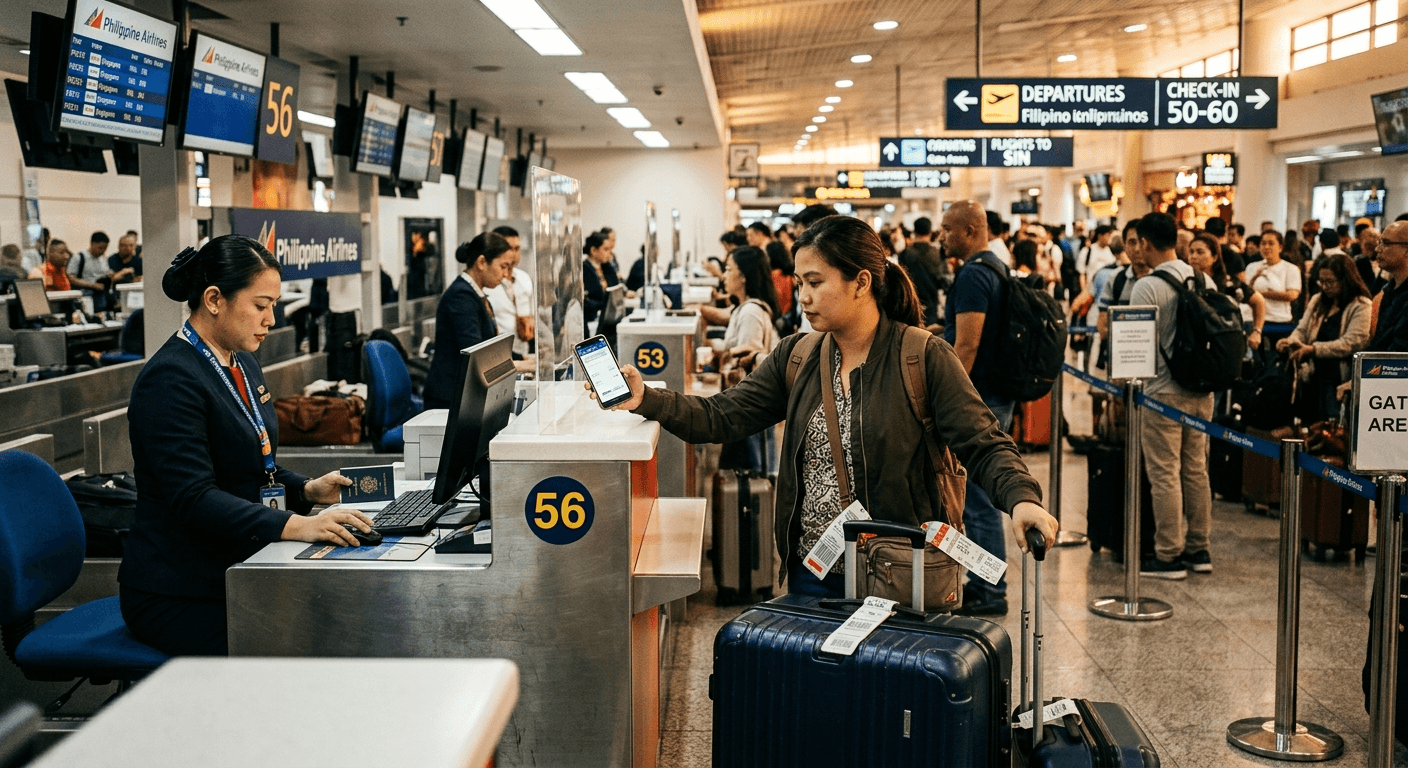
Airlines flying to the Philippines use the IATA TIMATIC system — a database of entry requirements for every country. When a check-in agent processes a one-way ticket to Manila or Cebu, TIMATIC flags the Philippines as requiring an onward ticket. The agent sees this flag and asks you to provide proof before issuing your boarding pass.
This happens at the departure airport — not in the Philippines. Travelers have been stopped in Hong Kong, Bali, Singapore, Seoul, and dozens of other departure points. You don't even make it to Filipino soil before the enforcement kicks in.
Airlines with documented strict enforcement for Philippines-bound flights include:
- Cebu Pacific Air — the most frequently cited airline in traveler reports, especially departures from Bali and Hong Kong. Check-in staff consistently ask one-way passengers for proof.
- Philippine Airlines (PAL) — PAL's own website explicitly states that a "valid return ticket(s) to the original port of origin or next port of destination for not more than 30 days from the date of arrival" is required.
- Cathay Pacific — enforces out of Hong Kong; there's a first-hand account from neverendingfootsteps.com of a traveler being stopped at HKG by Cathay staff on a Manila-bound flight.
- AirAsia — enforcement is less consistent than Cebu Pacific or PAL, but it does happen, particularly on routes from major Asian hubs.
Airlines have real liability here. If they fly you to the Philippines and you're denied entry, they're responsible for flying you back at their expense. That's why check-in agents take this seriously.
Philippine Bureau of Immigration (Arrival Check)
Once you land, Bureau of Immigration officers at NAIA (Manila) or Mactan-Cebu can also ask for your onward ticket. Community reports from Reddit's r/Philippines_Expats and TripAdvisor forums suggest this is less consistent than the airline check — many travelers report passing through without any question. But it does happen, and if you can't produce proof at this point, the consequences are worse: you could be denied entry and put on the next flight home at your own expense.
The safer approach: have your onward ticket ready at both checkpoints and don't rely on immigration being lax.
What Happens If You Don't Have an Onward Ticket
The outcomes range from inconvenient to expensive:
- Denied boarding — the airline won't issue your boarding pass. You miss your flight.
- Forced ticket purchase at the counter — the airline may offer to sell you a return ticket on the spot. Last-minute fares are brutal. Expect to pay 3–5x a normal fare.
- Denied entry on arrival — if you somehow made it on board without a check, immigration can still turn you around.
- Deportation at your expense — if denied entry after landing, you're put on the next available outbound flight. You pay for it.
None of these are good options. The cheapest solution — by a wide margin — is to get a philippines onward ticket sorted before you leave for the airport.
Don't risk it at check-in. Get your Philippines proof of onward travel in minutes → ticket-dummy.com
The Visa Extension Nuance: You Still Need a 30-Day Onward Ticket Even If You Plan to Stay Longer
This is the most misunderstood part of the Philippines onward ticket rule, and it catches long-stay travelers by surprise.
Yes, you can extend your stay in the Philippines well beyond 30 days. The extension process looks like this:
| Extension Stage | Duration | Visa Type | Fee (PHP, 2026) |
|---|---|---|---|
| 1st Extension | +29 days → 59 days total | Visa Waiver | ₱3,060 |
| 2nd Extension (from day 59) | +2 months | Tourist Visa 9(a) + ACR I-Card | ₱8,230 |
| Later extensions | +2 months each | Tourist Visa 9(a) | ₱4,080 |
| After 6 months continuous stay | +2 months | Tourist Visa 9(a) | ₱3,770 |
Here's the critical point: even if you fully intend to extend at the Bureau of Immigration, you must present an onward ticket within 30 days of arrival when you check in for your flight. "I'm going to extend my visa" isn't an acceptable substitute at the airline check-in counter. Saying that to a Cebu Pacific agent won't get you a boarding pass.
The good news: once you're inside the Philippines and you go to the Bureau of Immigration to extend your stay, you do not need to show an onward ticket again. The requirement applies at entry — not at subsequent extensions. Travelers at TripAdvisor's Philippines forum have confirmed this repeatedly.
So the practical approach for long-stay travelers: get an onward ticket that shows departure within 30 days (or 59 days if you're Brazilian or Israeli), use it to get into the country, then extend at the Bureau of Immigration once you're there. Simple.
What Counts as Proof of Onward Travel for the Philippines
Not everything passes as valid proof. Here's what works and what doesn't:
Accepted Proof
- A confirmed return flight to your home country, dated within your allowed stay window
- A confirmed onward flight to any other country, dated within your allowed stay window
- A verifiable PNR reservation (from an onward ticket service) — accepted by check-in staff if they can look it up in the airline system or GDS
- For 59-day nationals (Brazil, Israel): same as above, but within 59 days of arrival
What Does NOT Work
- Screenshots of unverifiable bookings — if the agent can't look it up, it doesn't count
- Fake or photoshopped documents — this is fraud and potentially illegal
- "I plan to extend my visa" as a verbal explanation
- Vague travel plans without a confirmed booking reference
The key word is "verifiable." A real PNR — one that exists in the Global Distribution System (GDS) and can be looked up — is what airline agents and immigration officers are looking for.
Your Options: How to Get Proof of Onward Travel for the Philippines
You've got a few routes here, depending on your situation and how much you want to spend:
Option 1: Book a Refundable Return Flight
Buy a return ticket on a fully refundable fare, use it to satisfy the onward ticket requirement, then cancel for a full refund after you arrive. Works in theory, but refundable fares are significantly more expensive than standard fares — and you need to be sure the fare is genuinely 100% refundable before relying on this plan.
Option 2: Book a Cheap Onward Flight You Actually Use
If you know you'll leave within 30 days anyway, just book the cheapest available flight to your next destination or home. AirAsia and Cebu Pacific often have promotional fares that are cheaper than the onward ticket services. This is the cleanest option if your plans aren't totally open-ended.
Option 3: Use an Onward Ticket Service
This is what digital nomads and flexible travelers use. Services like ticket-dummy.com provide a real flight reservation — with a genuine PNR that's verifiable in airline systems — for a fraction of the cost of a real ticket. The reservation is typically valid for 48 hours, which is enough time to check in, board, and arrive.
Pricing across the market runs from $9–$16 per ticket. ticket-dummy.com delivers instantly as a PDF. You show it at check-in, the agent verifies the PNR, you get your boarding pass. Done.
These are real reservations made through GDS systems — not fake documents. That's the important distinction. Using a service that provides a real, verifiable booking is legal and widely accepted. Using a photoshopped or fabricated document is fraud.
Step-by-Step: Getting Your Philippines Onward Ticket
- Go to ticket-dummy.com — enter your destination (Philippines/Manila or Cebu), your arrival date, and your nationality to confirm the required departure window.
- Choose your route — pick an outbound flight from the Philippines to anywhere. It can be to a neighboring country like Malaysia, Thailand, or Japan — doesn't matter where as long as the date is within 30 days of your arrival.
- Pay and receive your PDF — delivery is instant. You get a PDF with a real booking reference (PNR).
- Verify the PNR yourself — look up the booking reference on the airline's website to confirm it's findable. This is exactly what a check-in agent will do.
- Present at check-in — when the agent asks for your return or onward ticket, hand over the PDF (printed or on your phone). They verify the PNR, see it's valid, and issue your boarding pass.
- Optional: save a copy — store it in your email or phone in case Philippine Bureau of Immigration asks on arrival.
eTravel Registration: Don't Forget This Step
Separate from the onward ticket requirement, all passengers arriving in the Philippines must register on the Philippines eTravel Card portal within 72 hours of arrival. It's free. It replaced the old paper arrival and customs cards. If you don't do it before landing, you'll be directed to do it on arrival — but doing it in advance saves time at the airport.
Go to the official eTravel portal (etravel.gov.ph) and fill in your passport details, flight information, and health declaration. Takes about 5 minutes.
ACR I-Card Holders: Do You Still Need an Onward Ticket?
If you've done multiple long stays in the Philippines, you probably have an ACR I-Card (Alien Certificate of Registration) issued when you hit the 59-day extension mark. Some long-stay travelers assume their ACR history means they're exempt from the onward ticket requirement on return visits.
Community reports from expat forums suggest they're not exempt. The onward ticket requirement is primarily enforced by airlines, not immigration — and an airline check-in agent following TIMATIC rules will still flag your one-way ticket regardless of your ACR history. The practical advice from expat communities: just get an onward ticket. The cost ($9–$16) isn't worth the argument at check-in.
Philippines Immigration Onward Ticket: NAIA vs Regional Airports
The philippines immigration onward ticket requirement technically applies at all Philippine ports of entry, but travelers report that enforcement at regional airports (like Clark International, Davao, Kalibo for Boracay, or Puerto Princesa for Palawan) is generally less consistent than at NAIA or Mactan-Cebu. Don't rely on this. Airlines still enforce at the departure airport, wherever you're departing from.
Get Your Philippines Onward Ticket in Minutes
Don't risk getting denied boarding or turned away at immigration. ticket-dummy.com gives you a real, verifiable flight reservation with a genuine PNR — delivered as a PDF instantly, accepted at check-in counters for Philippines-bound flights.
For travelers on flexible itineraries, digital nomads, and anyone flying to Manila or Cebu on a one-way ticket, this is the fastest, cheapest way to satisfy the Philippines onward ticket requirement without locking yourself into a flight you may not take.
Get your Philippines onward ticket now → ticket-dummy.com
Instant delivery. Real PNR. Works for Cebu Pacific, PAL, AirAsia, and all major airlines flying into the Philippines.
See also: Countries that require an onward ticket — the full list of destinations where you need proof of onward travel before boarding.