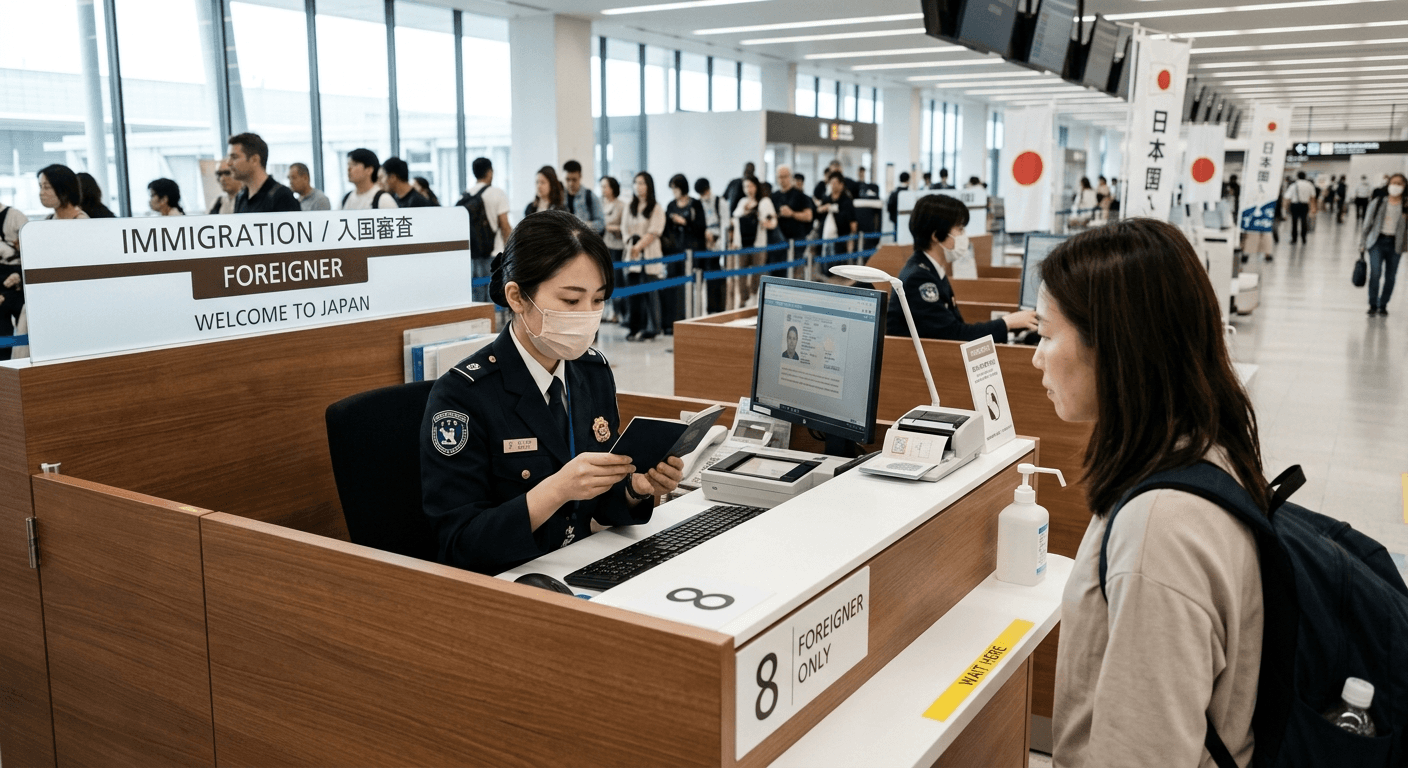
Onward Ticket for Japan 2026: Immigration Rules, Airlines & What to Do Tonight
It's 11pm. Your flight to Japan leaves tomorrow. You just realized you booked a one-way ticket — and now you're frantically Googling whether Japan requires an onward ticket. Good news: you found this page. Better news: you can fix this in about 10 minutes.
Japan is one of the easiest countries to visit visa-free. But it has one of the more actively enforced onward ticket for Japan policies at the airline level — and most travelers don't find out until they're standing at a check-in counter. This guide covers everything: what Japan immigration actually requires, how airlines like JAL and ANA enforce it, airport-specific tips for Narita, Haneda, and Osaka, plus the fastest way to get valid proof of onward travel tonight.
Need an onward ticket for Japan right now? Get a real, PNR-verified flight reservation delivered to your inbox in minutes. Get your Japan onward ticket → ticket-dummy.com
Does Japan Require an Onward Ticket?
The short answer: yes, in practice. Japan doesn't have a single law that says "every tourist must show an onward ticket." But Japan's immigration rules require visa-exempt tourists to have a confirmed departure plan within their allowed stay window. And airlines — who face fines and deportation costs if they board an inadmissible passenger — enforce this aggressively through IATA Timatic, the global database all airlines use to check entry requirements.
What that means for you: even if a Japanese immigration officer doesn't ask for your proof of onward travel for Japan, your airline almost certainly will. Especially if you're traveling on a one-way ticket.
This is the gap most travelers fall into. They know Japan lets them in visa-free. They don't realize the airline is the first checkpoint — and the airline has zero flexibility liability.
Who Gets Asked for Onward Proof
- One-way ticket holders of any nationality — this is the highest-risk scenario
- All visa-exempt tourists on short-term stays (90-day or 15-day waivers)
- Indian nationals on a Japan visa — airlines on India-Japan routes (especially JAL) are especially strict
- Transit passengers who must clear immigration — overnight connections, baggage reclaim stops, airport changes
- Travelers without Visit Japan Web pre-registration — may face slower processing and more scrutiny at the desk
What the Japan Onward Ticket Requirement Actually Means
The Japan onward ticket requirement doesn't mean you must have a return flight home. It means you need a confirmed, verifiable departure from Japan within your allowed stay period. That can be:
- A return flight back to your home country
- An onward flight from any Japanese airport to any international destination
- A PNR-verified flight reservation (including a dummy ticket with a live booking reference)
- A ferry booking out of Japan — for example, Fukuoka to South Korea
What does not work: hotel bookings, verbal assurances, domestic Japan flights, or expired/cancelled reservations. If an airline agent pulls up your booking reference and it comes back dead, you're getting sent back to the ticket counter.
Visa-Free Entry to Japan: Who Gets In and For How Long
Japan offers visa-free entry to over 70 nationalities. Most major Western countries get 90 days:
- USA, UK, Canada, Australia, New Zealand
- Most EU/EEA countries
- South Korea, Singapore, Hong Kong
Some nationalities receive only 15 days on a visa waiver. And some countries — India, China, Pakistan, Bangladesh, and much of Africa and the Middle East — require a Japan visa before travel.
Requirements for Visa-Free Entry in 2026
Beyond your passport, here's what Japan border control expects when you land:
- Valid passport with at least 6 months validity and 2 blank pages
- Completed Visit Japan Web registration (digital immigration and customs QR codes — strongly recommended, becoming near-mandatory at major airports)
- Onward or return ticket showing departure within your allowed stay period
- Proof of sufficient funds for your stay
- Accommodation address for your first night in Japan
- Digital travel authorization (new in 2026 for some nationalities — see section below)
For Travelers Who Need a Japan Visa
If you're applying for a Japan tourist visa at a Japanese embassy or consulate, you'll need a flight itinerary as part of your application. It does not need to be a fully paid ticket — Japanese consulates are used to seeing PNR-based temporary reservations. What matters is that the booking is verifiable and shows your planned dates in and out of Japan.
2026 Update: Japan's New Digital Pre-Authorization for Americans
This is the part many Americans haven't heard about yet. Japan is rolling out a digital pre-travel authorization system — similar in concept to Australia's ETA or the US ESTA — for certain visa-exempt nationalities, including American tourists.
What that means practically: before you board your flight to Japan, airlines will check not just for an onward ticket, but also for your digital pre-authorization clearance. If you haven't registered, you may be flagged at check-in even if every other document is in order.
The registration is done through the Visit Japan Web platform. It's free, takes about 15–20 minutes, and is strongly recommended for anyone flying to Japan in 2026. Do it before you pack.
Airports have also reported stricter secondary screening for travelers without clear exit documentation since the 2026 system rollout began. Having a printed or digital copy of your onward ticket ready — not just on your phone buried under 47 apps — saves time at the desk.
Airline Policies: JAL, ANA, Peach, and Jetstar Japan
Airlines don't make up their own onward ticket rules — they follow IATA Timatic, the industry-standard database that defines entry requirements for every country. But how strictly each carrier enforces it varies, and the difference between full-service and budget carriers matters here.
Japan Airlines (JAL)
JAL is one of the stricter carriers on this. Check-in agents actively verify onward bookings for passengers on one-way tickets — particularly on India-Japan routes, where JAL has a reputation for thorough document checks. A JAL agent can pull up your booking reference in their GDS system in real time. If it doesn't resolve under your name, it fails.
The implication: a screenshot of a booking confirmation isn't enough. Your reservation needs to be live and traceable at the time of check-in. A dummy ticket from a service that provides real PNR-verified reservations will pass this check. A fabricated PDF won't.
ANA (All Nippon Airways)
ANA follows the same IATA Timatic framework. Their online check-in system may flag missing onward documentation and redirect you to counter check-in for manual review. ANA's international check-in opens 24 hours before departure — if you're catching a flag at online check-in the night before your flight, that's your signal to sort out an onward ticket before you get to the airport.
Peach Aviation (LCC)
Peach is ANA's budget subsidiary and operates mainly domestic Japan routes plus some international flights to South Korea, Taiwan, and Southeast Asia. Less common as an entry point for non-Asian tourists, but relevant for travelers connecting through Japan or routing out via Peach. LCCs like Peach have less check-in agent discretion than full-service carriers — they follow the rules closely because they have limited liability buffers if things go wrong.
Jetstar Japan (LCC)
A Qantas/JAL joint venture operating primarily domestic Japan routes with some Asia connections. Same story as Peach: strict enforcement, less flexibility. If you're booking a budget carrier to get out of Japan as your "onward ticket," make sure that reservation is solid — cancelled or changed low-cost carrier bookings are a common source of onward ticket failures.
Budget Airlines vs. Full-Service Carriers
Here's a real pattern that experienced travelers notice: full-service carriers like JAL and ANA sometimes exercise judgment — a seasoned check-in agent might accept a flexible itinerary if everything else looks solid. Budget carriers almost never do. They follow the book, because not following the book is a liability they're not equipped to absorb.
If you're flying into Japan on a budget carrier — or routing out on one — have your onward proof airtight. No assumptions.
Don't risk denied boarding tomorrow. A PNR-verified onward ticket from ticket-dummy.com takes about 10 minutes to get. Get your Japan onward ticket now → ticket-dummy.com
Airport Notes: Narita (NRT), Haneda (HND), and Osaka (KIX)
Which airport you're flying in and out of matters more than most people realize. Here's what's different at each one.
Narita International Airport (NRT) — Tokyo
Narita handles the majority of Tokyo's long-haul international flights. It has three terminals: Terminal 1 (Star Alliance/SkyTeam), Terminal 2 (oneworld and others), and Terminal 3 (LCCs). Immigration at Narita can involve long queues during peak seasons — Visit Japan Web QR codes visibly speed things up, while manual document checks add time.
Narita immigration officers do ask for onward proof during secondary screening, particularly for visa-exempt travelers on one-way tickets. The airport closes airside areas overnight (operating hours 06:00–00:00), so there are no airside overnight stays — overnight connection travelers must clear immigration, which triggers the same onward ticket checks.
Haneda Airport (HND) — Tokyo
Haneda is closer to central Tokyo and handles a growing share of international routes alongside a heavy domestic schedule. Its single international terminal (Terminal 3) processes immigration the same way Narita does. The enforcement level is consistent between the two Tokyo airports — don't assume Haneda is more relaxed because it's smaller.
One thing to know: some travelers fly into Tokyo (NRT or HND) and depart Japan from Osaka (KIX) after traveling through the country. That's completely fine — but your onward ticket needs to show the right departure airport. An onward ticket departing from NRT when you're actually leaving from KIX will raise questions at immigration and check-in.
Kansai International Airport (KIX) — Osaka
KIX is the gateway to western Japan — Osaka, Kyoto, Nara, Kobe. International arrivals process through Terminal 1. KIX immigration is considered thorough; travelers departing Japan from Osaka need clear onward documentation matching KIX as their departure airport.
One routing issue that catches travelers: arriving NRT, spending two weeks in Japan, then departing KIX. If your onward ticket shows NRT as the departure city, that's a mismatch — an immigration officer or airline check-in agent may question it. Get the ticket right the first time. If your exit airport changes, update the booking before you travel.
Domestic-to-international connections at KIX also require full immigration clearance at T1 arrivals, so even if you're connecting from an internal Japan flight, you'll go through the same checks.
Working Holiday Visa Holders: What's Different
Japan has Working Holiday Visa (WHV) agreements with over 30 countries including Australia, New Zealand, Canada, UK, Ireland, France, Germany, South Korea, and many others. If you're on a WHV, the onward ticket situation is a bit different — but not completely off the hook.
WHV allows stays up to 1 year, sometimes extendable. You're not held to the 90-day tourist departure window, and immigration officers see the WHV stamp and know the 1-year limit applies. That softens the onward proof expectation compared to a tourist entry.
But here's where WHV holders still run into problems: airlines. An airline check-in agent sees a one-way ticket to Japan and questions it regardless of your visa category. They're looking at Timatic, and Timatic shows Japan requires departure documentation. They may not know or care that you have a 12-month WHV — their job is to verify you're not going to be refused entry.
Best practice for WHV holders: book an onward ticket showing departure from Japan within 12 months. A cheap dummy ticket works. You don't have to actually use it — you can cancel or change it once you're settled in Japan and know your real plans. What you don't want is a one-way ticket and no exit documentation at check-in, especially if you're flying a budget carrier or on a route with tight enforcement like India-Japan or Southeast Asia-Japan.
Also: WHV overstays result in bans from future Japan entry. Keep your paperwork clean from day one.
How to Get Proof of Onward Travel for Japan Tonight
You've got a few options, and the right one depends on how much time you have and what your travel plans actually are.
Option 1: Book a Real Onward Flight
If you know where you're going after Japan, just book it. Even a cheap one-way flight from Tokyo to Seoul, Bangkok, or Singapore satisfies the requirement. Airfare within Asia can be very affordable — sometimes under $50 on Jetstar, Peach, or Scoot.
The downside: if your plans change, you lose money on a non-refundable ticket.
Option 2: Book a Refundable Fare
Some airlines offer fully refundable tickets at a premium. Book one, use it as proof, cancel after you're through immigration. Legitimate — but expensive, and the cancellation window needs to extend past your planned stay.
Option 3: Get a PNR-Verified Dummy Ticket
This is the most popular option for travelers who don't know their exit plans or don't want to commit money to a ticket they might not use. A dummy ticket is a real flight reservation with a live, verifiable booking reference — not a fake PDF, not a screenshot, but an actual PNR that can be confirmed in the airline's system.
Services like ticket-dummy.com deliver these within minutes. The booking is valid for airline check-in verification and for visa applications. You get a PDF confirmation with all the details an airline agent or immigration officer would expect to see.
Important: use a service that provides actual PNR-verified reservations. A fabricated document is fraud and will fail the second an agent tries to verify it. A live reservation will pass.
Step-by-Step: Get Your Onward Ticket Tonight
- Go to ticket-dummy.com
- Enter your departure details — pick any international route out of Japan that matches your planned exit airport (NRT, HND, KIX, etc.)
- Enter your name exactly as it appears on your passport
- Complete checkout (takes about 5 minutes)
- Receive your PDF confirmation with booking reference by email — usually within minutes
- Screenshot it, save it to your phone, email it to yourself — have it accessible at check-in
That's it. Problem solved before midnight.
Ready to fix this right now? Get a verified onward ticket for Japan in minutes, delivered straight to your inbox. Get your Japan onward ticket → ticket-dummy.com