Do You Need an Onward Ticket for Thailand? 2026 Guide (What Actually Gets Checked)
Short answer: yes, you need an onward ticket for Thailand — and in 2025/2026 the stakes got real. Thai immigration refused entry to roughly 2,900 foreigners in a single enforcement sweep after rolling out a nationwide crackdown on visa-exempt travelers. That number isn't a scare tactic. It's what happens when you show up with a one-way ticket, no clear exit plan, and an immigration officer who's been told to start enforcing rules that were always on the books.
This guide covers everything: the legal requirement, who actually enforces it (spoiler: it's your airline more than immigration), which airlines are the strictest, what each major Thai airport looks like, and your cheapest options to get sorted before you fly.
Need proof of onward travel fast? Get an instant, PNR-verified onward ticket at ticket-dummy.com — delivered in minutes, accepted at check-in and immigration.
The Quick Answer: Do You Need an Onward Ticket to Enter Thailand?
| Entry Type | Onward Ticket Required? | Who Checks It |
|---|---|---|
| Visa Exemption (93 countries, up to 60 days) | ✅ Yes — officially required | Airline check-in + sometimes immigration |
| Visa on Arrival (VOA) | ✅ Yes — explicitly on the VOA form | VOA counter (always), airline check-in |
| Non-Immigrant Visa (B, O, O-A, Multi-entry) | ❌ Not required | N/A — one-way tickets are fine |
| Tourist Visa (TR) | ✅ Yes — required at airline check-in | Airline check-in primarily |
ThaiEmbassy.com is blunt about it: "If they don't possess a ticket proving their exit from Thailand within 60 days of arrival, they will most likely be refused entry." The legal hook is Section 12 of Thailand's Immigration Act, which lets officers deny entry for "insufficient means of living" — no exit proof counts as one of those grounds.
The 60-day stay is a relatively new change (previously 30 days). That's good news for long-stay travelers. The bad news: enforcement has intensified at the same time.
What "Onward Ticket" Actually Means Here
An onward ticket is proof that you'll be leaving Thailand before your permitted stay expires. Specifically:
- A confirmed flight out of Thailand — international, departing within your permitted stay window
- A PNR (booking reference) that can be looked up on the airline's website — your name, route, and date must all be visible
- Departure must be from Thailand to another country — a Bangkok–Chiang Mai flight does nothing here
What doesn't count: domestic flights, screenshots that can't be verified, anything with a departure date outside your permitted stay, and — according to some Thai Embassy sources — tickets to neighboring countries only (though this last point is inconsistently enforced in practice; a flight to Malaysia is usually fine, but a flight to a non-neighboring country like Singapore, Japan, or Hong Kong is safer).
The Two Places Your Onward Ticket for Thailand Gets Checked
1. Airline Check-In (the main checkpoint)
This is where most travelers actually get caught. Under IATA TIMATIC rules, every airline is financially liable if it boards a passenger who gets refused entry at the destination. If you land in Bangkok and get turned around, the airline that flew you in must carry you home — at their expense — and may face fines from Thai immigration. That liability makes check-in agents take this seriously.
Budget carriers are especially strict. They have rigid TIMATIC checklists and less agent discretion. You might clear check-in, then get stopped again at the gate. It happens.
2. Immigration on Arrival (increasingly enforced)
For most first-time tourists with a clear itinerary, Thai immigration is a formality. But that changed in 2025. The 2,900 refusals came from a targeted enforcement policy aimed at travelers who were treating visa exemptions like long-term visas — entering every 60 days, no onward ticket, vague answers about what they're doing.
If you've been to Thailand multiple times, if you're arriving at Don Mueang on a budget carrier, or if your answers at the desk are hesitant, you're more likely to face questions. And since May 2025, you also need to complete the TDAC (Thailand Digital Arrival Card) online within 72 hours before arrival — it replaces the old paper TM6 form. Your onward flight details will be entered in that form, so any inconsistency is visible before you even reach the desk.
The 2025 Crackdown: What Actually Changed
Thailand didn't pass new laws. They enforced existing ones harder. Here's what's different now:
- Land/sea entries capped at 2 per calendar year for visa-exempt travelers — the classic "visa run to Malaysia, come back next day" loop is over
- Coordinated national enforcement — not just one strict officer, but a policy directive across all entry points
- Digital profiling via TDAC — your entry/exit history is visible to officers before you open your mouth
- ~2,900 foreigners refused in early 2025 — officers are actively applying the rules, not looking the other way
- Intent scrutiny — if you look like you're living in Thailand on tourist exemptions, expect questions about accommodation, work, and funds (10,000 THB per person / 20,000 THB per family required)
The rule about needing a Thailand onward ticket isn't new. What's new is the consequences for not having one are now real, not theoretical.
Airline-by-Airline: Who Checks Hardest
Your airline determines your first obstacle. Here's how the major carriers handling Thailand routes compare:
AirAsia — Strictness: Very High ⚠️
AirAsia is consistently reported across traveler forums, Reddit, and visa-run communities as the most rigorous enforcer. They follow TIMATIC checklists with near-zero agent discretion. Reports include being called to the counter before boarding specifically to show an exit ticket from Thailand — even when you've already checked in. Enforcement can happen at the gate, not just the check-in desk. AirAsia flies to Don Mueang (Bangkok), Phuket, Chiang Mai, and Hat Yai. If you're flying AirAsia anywhere near Thailand, have your proof of onward travel for Thailand ready before you even get to the airport.
Thai Lion Air / NokScoot / Scoot — Strictness: High
The full budget carrier bracket. Same TIMATIC-driven enforcement as AirAsia. Scoot (Singapore-based) is known to check at its Singapore hub before boarding for Bangkok. Thai Lion Air applies checks at check-in for routes originating outside Thailand. Don't assume any LCC is lenient.
Thai Airways — Strictness: Medium-High
Full-service carrier, so agents have more discretion. But "more discretion" doesn't mean they skip the check — it means they might accept a less-than-perfect document or a brief explanation. Thai Airways operates out of Suvarnabhumi. Consistently asks for onward proof on Bangkok routes, especially for one-way ticket passengers.
Bangkok Airways — Strictness: Medium
Bangkok Airways explicitly reminds passengers that they're "solely responsible for preparing travel documents before travelling." International passengers must present themselves at the Self Service Check-in Counter 90+ minutes before departure. The gate reminder specifically flags document verification for destination countries. They'll check — they're just more polite about it.
Full-Service International (Emirates, Qatar, British Airways, Cathay Pacific) — Strictness: Medium
These carriers enforce TIMATIC but agents have the most discretion. That said, "they're less strict" doesn't mean you should gamble. Emirates and Qatar flights to Bangkok absolutely ask for onward tickets for one-way passengers on visa exemption. A refundable Cathay Pacific ticket to Hong Kong (24-hour free cancellation available on all fare classes) is a clean solution if you're flying via HKG.
Airport-by-Airport: What to Expect in Thailand
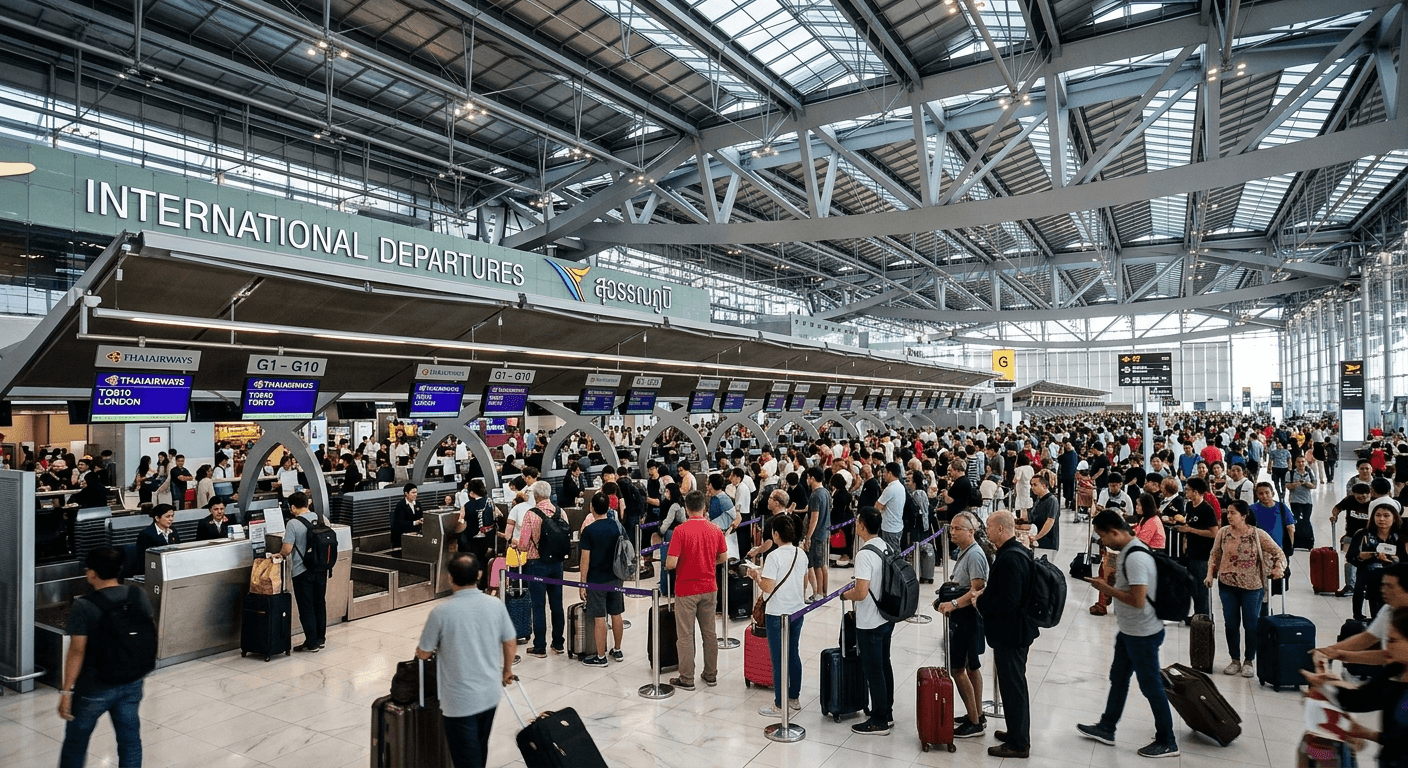
BKK — Suvarnabhumi, Bangkok
Thailand's main international hub. Immigration here processes thousands of people daily, which means most tourists just flow through. That said, BKK has a dedicated VOA counter where onward ticket details are on the application form — no departure booking means your VOA application stalls. TDAC QR code is required before joining the immigration line. Fast-track immigration is available (pre-bookable) but doesn't waive documentation. Peak queues: 5–9 AM and 4–8 PM.
DMK — Don Mueang, Bangkok
The budget airline hub — AirAsia, Thai Lion Air, NokAir. Don Mueang is reportedly stricter than Suvarnabhumi for immigration scrutiny, partly because it's a smaller airport where officers have more direct contact with individual passengers. Most traveler reports about being questioned at Thai immigration on arrival come from DMK arrivals, not BKK. Combined with AirAsia operating most of the outbound routes from this airport, it's the highest-friction entry point for budget travelers. Have everything ready.
HKT — Phuket International
High volume of European and Australian tourists, mostly beach-oriented. VOA is available. Immigration is generally less crowded than Bangkok. No specific reports of Phuket being unusually strict or lenient — treat it the same as BKK. Budget carriers like AirAsia and Scoot fly to Phuket and will check your onward ticket at the origin airport before you ever board.
CNX — Chiang Mai International
The northern Thailand hub, popular with digital nomads and long-stay travelers. Shorter queues, VOA available. The digital nomad demographic here means immigration officers are likely more familiar with the "I'm just here to work remotely for a while" profile — which, since the 2025 crackdown, is exactly the profile getting extra scrutiny. CNX isn't uniquely strict, but the type of traveler arriving here is more likely to get asked questions. Having a clear onward ticket removes the most obvious red flag.
What Counts as Valid Proof of Onward Travel for Thailand
Ranked from most to least reliable:
- Confirmed international flight out of Thailand — PNR-verified, name matches passport, departure within your permitted stay window. This is the gold standard. Accepted by every airline and at every immigration desk.
- Temporary onward ticket (e.g., ticket-dummy.com) — a real reservation with a verifiable PNR. Not a fake document. The reservation is a genuine hold on the airline booking system. Accepted at airline check-in and by immigration. Valid for 24–48 hours. Cost: around $9–15. Tens of thousands of travelers use these every year.
- Refundable flight ticket — book a refundable fare, show it at check-in, cancel after you clear immigration. Cathay Pacific, full-service carriers often have refundable options. More expensive but 100% clean.
- Bus or train ticket out of Thailand — technically valid but practically risky. Harder for check-in staff to verify. Sometimes accepted at land border immigration, less reliably at airports. Only use this as a backup if you genuinely have a booked overland departure.
- What won't work: Screenshots that can't be verified, fake PDFs, domestic Thailand flights, departure dates outside your permitted stay.
Don't have an onward flight yet? A dummy onward ticket from ticket-dummy.com gives you a real PNR-verified reservation — accepted at check-in and immigration — while you figure out your actual plans. Instant PDF delivery, starting from $9.
The TDAC System: What It Means for Your Onward Travel Documents
Since May 2025, the physical TM6 arrival card is gone. Every traveler now completes the Thailand Digital Arrival Card (TDAC) online within 72 hours before arrival. You'll enter your:
- Passport details
- Accommodation address in Thailand
- Flight details (inbound and outbound)
- Contact information
You get a QR code to show at immigration. The point is that your onward flight information is now in a system before you arrive — meaning if you're asked about your exit ticket at the desk, they can see what you entered in TDAC. Any inconsistency between what you said and what's in the system creates friction. Fill this out honestly and with your actual onward ticket details.
Land Border Entry: The 2/Year Cap
If you're entering Thailand by land or sea on a visa exemption, there's now a hard cap of 2 entries per calendar year. The old "visa run to Poipet or Sadao every month" strategy is no longer viable. The land entry cap applies even if you've been inside Thailand for a while — it counts calendar entries, not days between trips.
For air entries, there's no stated hard cap, but consecutive visa-exempt travelers are increasingly profiled. If your passport shows you've entered Thailand 6 times in the past 12 months, expect more questions regardless of how you arrived.
What Happens If You're Refused or Denied Boarding
Two failure modes:
Denied boarding by your airline: The airline refuses to let you on the plane at your origin airport. Your fastest fix: pull up ticket-dummy.com on your phone, get a verified reservation in the next 15–20 minutes, show it at the desk or gate. This works. It's exactly what the service is designed for.
Refused entry by Thai immigration on arrival: More serious. You'll be held, then placed on a return flight at your expense (or the airline's, depending on circumstances). This is rare for first-time normal tourists. It's much more likely if you have multiple Thailand entries in your history and no clear documentation of your purpose. Your best defense is having everything right before you land — onward ticket, TDAC completed, accommodation confirmed, funds available.
Quick-Reference Checklist Before You Fly to Thailand
- ✅ Passport valid for at least 6 months from entry date
- ✅ TDAC (Thailand Digital Arrival Card) completed online within 72 hours before arrival
- ✅ Onward ticket showing international departure from Thailand — within your permitted stay window
- ✅ Onward ticket has a verifiable PNR (can be looked up on the airline's website)
- ✅ Accommodation confirmed for at least the first few nights
- ✅ Funds: 10,000 THB per person (approx. $280 USD) or 20,000 THB per family
- ✅ If entering by land/sea: confirm this isn't your 3rd+ visa-exempt land entry this calendar year
For the full list of countries that require an onward ticket (not just Thailand), see our countries that require onward ticket guide.